

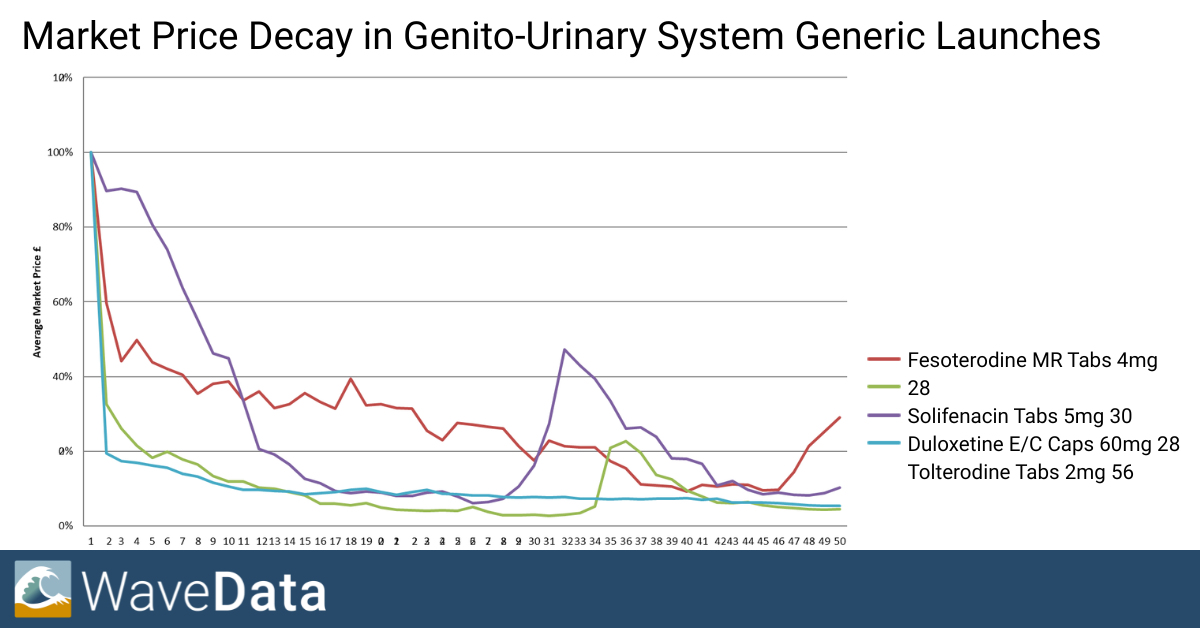
We often get asked to provide historical market prices so that manufacturers can gain an understanding of the competition their brand is likely to face after loss of exclusivity. The request often comes attached to the medication‘s indication, as it would be logical to assume the drugs in the same class would behave in similar ways. However, from experience we found this is not the case at all.
We have to put our heads in the same mindset as the generic manufacturer. The process they use to create the generic version of your brand focus primarily on value rather than constituent chemistry. This means that they will look at each potential loss of exclusivity situation and gauge attractiveness based on the value of the originator brand, as well as secondary factors like reimbursement and Drug Tariff Category. Additionally, they’re manufacturing for more countries than just the UK, so their focus will be on brand value worldwide. This means that a worldwide brand that sells in the billions of $ dollars will be more attractive than one that sells in the hundreds of millions of $ dollars.
The indication and the constituent molecule only really comes into play when it’s very unusual and complex. We see this with combined products and devices, such that the manufacturing process is more complicated than normal. Having a cream, or an inhaler does protect you against generics as does very unusual chemistry. For example while biologics are not immune to competition, they are much more complicated than small molecule products.
This means that once generic versions of your brand do appear on the UK market, the rate of which the price decays will be very different from your originator brand. This is primarily because it’s value the drives price decline rather than therapeutic indication.